
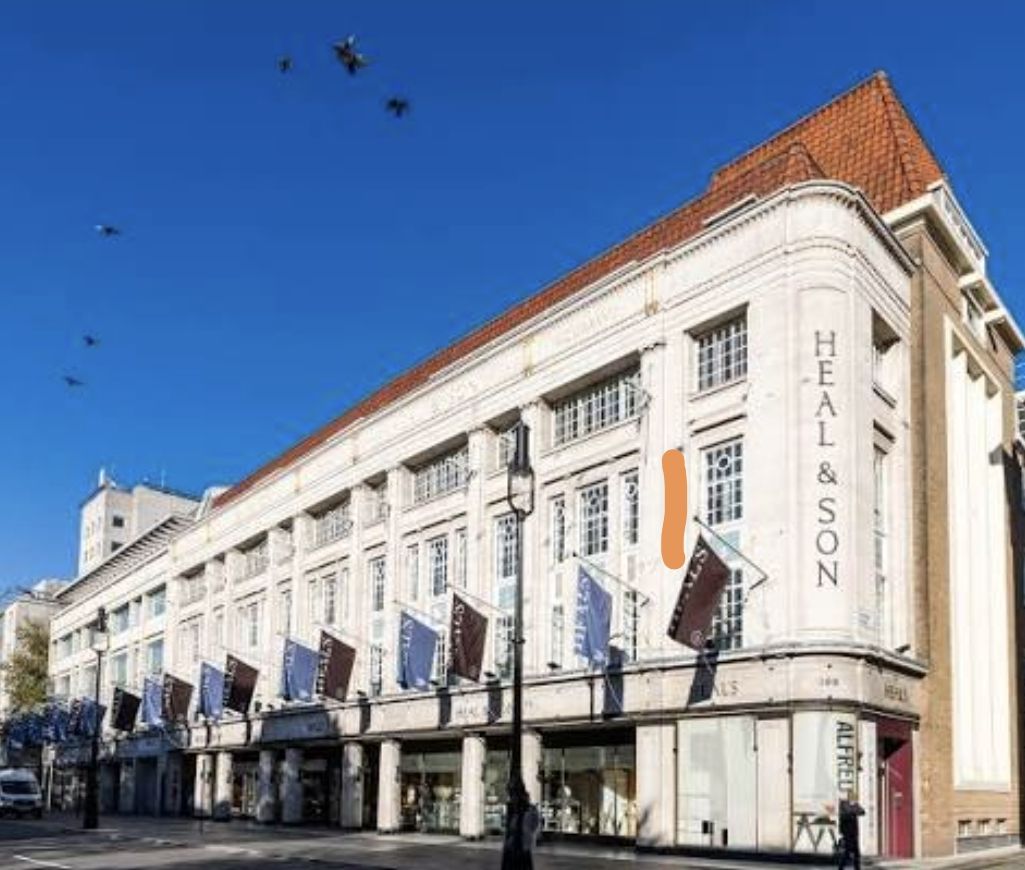
For over a century, the Heal’s Building on Tottenham Court Road has been more than a temple to high-end furniture; it has been a landmark of architectural refuge. But as the building’s new corporate owners, KKR and General Projects, move forward with their “repositioning” of the site as The Manufactory, a new and cynical feature has appeared: the strategic planter.
We are aware that these changes—the installation of further barriers and planters designed to permanently displace the community—will be attempted tomorrow (Wednesday 6 May). This is not an isolated incident, but a coordinated attempt to physically erase the presence of the vulnerable before the city wakes up. We urge the local community, the press, and supporters of the right to the city to be present and witness this act of exclusion.
A Pattern of Exclusion Across the Neighbourhood
This move at Heal’s is not happening in a vacuum. We have noticed a disturbing trend recently where nearby areas have been subjected to the same “defensive” tactics. From the alcoves of Warren Street to the pavements surrounding University College Hospital, we are seeing the systematic installation of “hostile greenery” and bike racks in spots traditionally used for shelter. It appears to be a broader campaign to “cleanse” the Fitzrovia and Bloomsbury corridors, pushing the homelessness crisis out of sight rather than addressing it with humanity.
A Pavement Born of Political Neglect
The people forced to occupy this stretch of London for the last few decades is the physical manifestation of repeated, catastrophic failures by both Camden Council and Central Government. For years, we have seen a merry-go-round of “initiatives” that never address the root cause. Central Government’s failure to fix a broken private rental sector and the sustained gutting of mental health services have pushed people onto the streets. Meanwhile, the local council has too often settled for “managing” the visible signs of poverty rather than housing the people behind them.
The Grassroots Safety Net
Where the state has retreated, the community has stepped in. For years, local grassroots groups and independent volunteers have been the only true safety net for the people outside Heal’s. Groups like Streets Kitchen and local mutual aid networks have provided advocacy, medical signposting, and a sense of belonging. Their work is a testament to the fact that while the authorities may have looked away, the people of London have not.
Solidarity vs. Corporate Coldness
In the face of systemic collapse, the only thing that has remained constant is human solidarity. We are acutely aware that the shop floor staff at Heal’s have always been sympathetic, treating rough sleepers with a level of courtesy and decency that stands in stark contrast to the coldness of corporate property management. Staff, security, and local volunteers have historically managed this space with empathy. By attempting to install these barriers tomorrow, the new landlords are overriding the compassionate precedent set by their own workforce.
”Greenery” as the Final Act of Exclusion
These planters are not an act of ecology; they are the final layer of a hostile system. Having been failed by the council’s housing department and the government’s welfare net, the vulnerable are now being “designed out” by private capital. It is a physical eviction carried out under the guise of horticulture, ensuring that the wreckage of our social safety net is hidden from high-end commercial tenants.
A Call for Collective Responsibility
The struggle at Heal’s is a microcosm of a larger battle for the soul of London. We stand in solidarity with the staff of Heal’s, the grassroots volunteers, and the residents of the Tottenham Court Road pavement. We call for:
- An Immediate Halt to Defensive Urbanism: Stop the installation scheduled for tomorrow.
- An End to the Neighbourhood-Wide “Cleansing”: Demand a stop to the coordinated use of hostile architecture across Fitzrovia.
- Political Accountability: Demand that Camden Council and Central Government stop passing the buck to private security.
London does not need more “active frontages” that are closed to those in need. We need a city that is designed to include, not to exclude. It is time to stop using nature as a barrier to hide the wreckage of our social safety net. In a city of rising rents and disappearing spaces, solidarity is our only shelter.